
 06N / 07DAssam
6 Night 7 Days Assam and Meghalaya
- Kaziranga National Park
- Majuli Island
- Kamakhya Temple
- Manas National Park
From ₹24,500
View tourTea gardens, one-horned rhinos and the mighty Brahmaputra.
Why Assam
Assam is the gateway to the Northeast — a green sweep of tea estates, river islands and grassland reserves where the one-horned rhino still roams free. Turopia crafts Assam holidays that balance wildlife safaris in Kaziranga and Manas with the living Vaishnavite culture of Majuli and the spiritual pull of Kamakhya.
Kaziranga National Park
Majuli Island
Kamakhya Temple
Manas National Park
Guwahati
Packages
9 curated itineraries — every one of them customizable on dates, hotels and pace.
06N / 07DAssamFrom ₹24,500
View tour06N / 07DAssamFrom ₹24,500
View tour04N / 05DAssamFrom ₹17,500
View tour06N / 07DAssamFrom ₹24,500
View tour04N / 05DAssamFrom ₹17,500
View tour04N / 05DAssamFrom ₹17,500
View tour04N / 05DAssamFrom ₹17,500
View tour04N / 05DAssamFrom ₹17,500
View tour04N / 05DAssamFrom ₹17,500
View tourIn depth
Assam sits in the lap of the Brahmaputra, a river so wide in places that the far bank disappears into haze. The state is the gateway to all seven Northeastern states, and it carries that role well: an international airport at Guwahati, a dense rail network, and highways that fan out towards Meghalaya, Arunachal Pradesh and Nagaland. What keeps travellers here rather than just passing through is the combination of grassland wildlife, tea estate landscapes and a Vaishnavite culture that has survived almost unchanged for five centuries.
A typical Turopia Assam itinerary threads Guwahati's temples and river cruises with jeep safaris in Kaziranga, a slow ferry to the river island of Majuli, and a heritage bungalow stay among the tea gardens of Jorhat or Dibrugarh. Distances look small on a map but road journeys follow the river, so we build in generous drive time and stop for Assamese thali lunches along the way.
Must-visit places
Kaziranga National Park
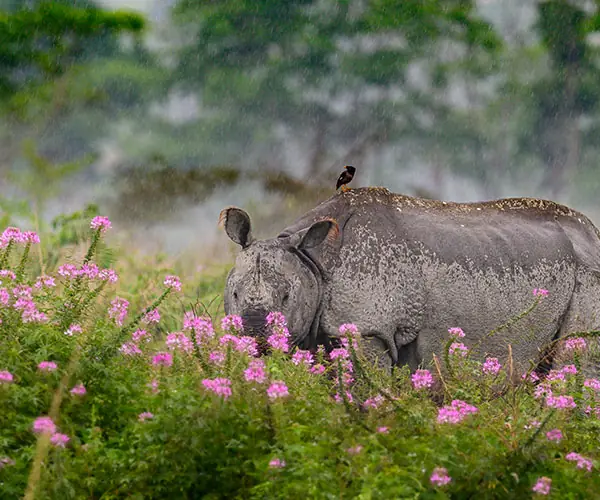
A UNESCO World Heritage site holding roughly two-thirds of the world's greater one-horned rhinoceros population, along with wild water buffalo, swamp deer and one of India's highest tiger densities. The park is split into Central (Kohora), Western (Bagori), Eastern (Agaratoli) and Burapahar ranges; we book jeep safaris in two different ranges so you see both the tall elephant grass and the wetland beels. Elephant-back safaris run at dawn in Kohora and Bagori and must be reserved weeks ahead.
Majuli Island
The world's largest river island, reached by a government ferry from Nimati Ghat near Jorhat. Majuli is the heart of Assam's Neo-Vaishnavite movement, with satras (monasteries) where celibate monks still perform Sattriya dance and make the painted masks used in bhaona theatre. Samaguri Satra for masks, Kamalabari and Auniati for dance and manuscripts, and the Mishing stilt villages on the eastern side are the standard circuit.
Kamakhya Temple
Perched on Nilachal Hill above Guwahati, Kamakhya is one of the most revered Shakti Peethas in India and the focus of the Ambubachi Mela each June, when hundreds of thousands of pilgrims arrive. The temple's beehive-shaped shikhara is classic Nilachal architecture. Turopia arranges early-morning darshan slots to avoid the mid-morning crush, and pairs the visit with the Umananda island temple on the Brahmaputra.
Manas National Park
A tiger reserve and biosphere on the Bhutan foothills, quieter and wilder than Kaziranga, home to golden langur, pygmy hog, hispid hare and Bengal florican — species you will struggle to see anywhere else. River rafting on the Manas and a stay at a community-run eco camp at Bansbari make this the best two-night add-on in western Assam.
Sivasagar and the Ahom Heritage
The capital of the Ahom dynasty that ruled Assam for 600 years and repeatedly beat back Mughal armies. The Rang Ghar amphitheatre, the seven-storey Talatal Ghar with its underground tunnels, Kareng Ghar palace and the temple tanks of Sivasagar make a full day of genuinely underrated history between Jorhat and Dibrugarh.
Jorhat and Dibrugarh Tea Country
Assam produces over half of India's tea, and the colonial-era planters' bungalows around Jorhat and Dibrugarh have been converted into some of the most atmospheric stays in the Northeast. Estate walks with a planter, tasting sessions in the factory, and evenings on a verandah surrounded by manicured green — this is the slow half of an Assam trip.
Best time to visit
Peak season · November – March
Dry, cool and clear. Kaziranga and Manas are open (they usually shut from mid-May to October), grass is being burnt back so rhino sightings are excellent, and the Brahmaputra is calm enough for cruises. Book Kaziranga stays six to eight weeks ahead for December and January.
Shoulder season · April – May
Warm and humid with pre-monsoon showers, but Bihu celebrations in mid-April are the state's biggest festival and worth planning a trip around. Park ranges start closing towards the end of May.
Monsoon · June – October
Heavy rain, flooded plains and closed park gates. Majuli and the tea gardens are luminous green and hotel rates drop sharply, so this suits culture-focused trips rather than wildlife.
How to reach
Travel tips
What to eat: Assamese food is subtle and river-led: masor tenga (sour fish curry with tomato or thekera), khar made with raw papaya and filtered ash water, duck with ash gourd, black sesame chicken, and pitha rice cakes at Bihu.
Culture: Sattriya, one of India's eight classical dance forms, was born in Majuli's monasteries. Bihu — Rongali in April, Kongali in October and Bhogali in January — punctuates the Assamese year.
FAQs
How many days do I need for Assam?
Five nights covers Guwahati, Kaziranga and a tea-garden stay comfortably. Add two nights if you want Majuli, and two more for Manas.
Do I need a permit for Assam?
No Inner Line Permit is required for Assam. Foreign nationals only need to register at some park entry points, which our representative handles.
Is Kaziranga open all year?
No. The park normally closes from mid-May to end October due to monsoon flooding, reopening around 1 November. Exact dates vary each year.
Are rhino sightings guaranteed?
Nothing in the wild is guaranteed, but Kaziranga has one of the highest large-mammal sighting rates in India — most guests see multiple rhinos on their first safari.
Share your dates and we'll build the itinerary, book the stays and handle every permit.