
 04N / 05DMeghalaya
Meghalaya Tour Packages
Living root bridges, waterfalls and the cleanest village in Asia.
Why Meghalaya
Holidays in Meghalaya, planned by people who travel there
Meghalaya is the abode of clouds — limestone caves, turquoise rivers at Dawki, double-decker root bridges and rain-washed Shillong. Our Meghalaya trips are built around the weather so you catch the falls at their most dramatic.
Cherrapunji
Living Root Bridge
Mawlynnong
Dawki
Shillong
Packages
Meghalaya tour packages
2 curated itineraries — every one of them customizable on dates, hotels and pace.
04N / 05DMeghalayaIn depth
Meghalaya — The Abode of Clouds
Meghalaya is a limestone plateau tipped towards the Bangladesh plains, which is why it catches more rain than almost anywhere on earth and why its rivers run turquoise over white stone. The Khasi, Jaintia and Garo hills hold living root bridges grown over decades from rubber-fig roots, caves that rank among the longest in Asia, and waterfalls that drop hundreds of metres in a single throw.
A Turopia Meghalaya trip usually bases two nights in Shillong, two in Cherrapunji (Sohra) and one in Dawki or Shnongpdeng, with the double-decker root bridge trek at Nongriat as the physical centrepiece — 3,000 steps down and the same back up, which we always schedule as a full day.
Must-visit places
Places worth your days
Double Decker Living Root Bridge, Nongriat
Two stacked bridges of woven ficus root over the Umshiang stream, grown by Khasi villagers across generations. The trek from Tyrna is roughly 3,500 steps each way and takes 4 to 6 hours return; most travellers who stay overnight at Nongriat say it was the best decision of their trip. Add the Rainbow Falls hike for another two hours each way.
Cherrapunji (Sohra) Waterfalls
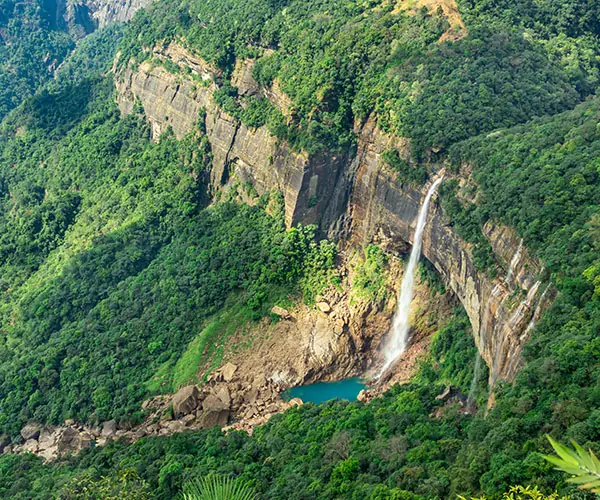
Nohkalikai, India's tallest plunge waterfall at 340 metres, Seven Sisters (Nohsngithiang), Dainthlen and Wei Sawdong's three-tier turquoise pools. All are within an hour of Sohra, and all are at their most dramatic from June to September.
Dawki and the Umngot River
In the dry season the Umngot at Dawki runs so clear that boats appear to float on air. Shnongpdeng, a few kilometres upstream, is quieter and offers kayaking, cliff jumping, zip-lining and riverside camping with the Bangladesh border in view.
Mawlynnong
Billed as Asia's cleanest village — bamboo dustbins on every path, flower-lined lanes, a sky-walk viewing platform over the plains and a smaller single-decker root bridge at nearby Riwai.
Mawsmai and Arwah Caves
Lit limestone caves with stalactites, narrow squeezes and fossil beds. Mawsmai is the easy 150-metre walk-through; Arwah is quieter and has visible marine fossils in the rock.
Laitlum Canyons and Shillong
Laitlum's grassy ridge drops into a green amphitheatre an hour from the city. Shillong itself gives you Ward's Lake, Police Bazar, the Don Bosco Museum's seven floors of tribal ethnography and a live-music scene that earned the city its 'rock capital' reputation.
Best time to visit
Best overall · October – April
Dry, clear and comfortable. The Umngot is at its most transparent from November to March and treks are dry underfoot.
Waterfall season · June – September
Monsoon turns every cliff into a waterfall and Nohkalikai into a torrent, but trails are slippery, leeches are active and views can be cloud-locked.
Shoulder · May
Warm, green and pre-monsoon — good value, occasional afternoon storms.
How to reach
- By air
- Guwahati (GAU) is the practical gateway, 3 to 3.5 hours by road to Shillong. Shillong's own Umroi airport (SHL) has limited flights from Kolkata and Delhi.
- By rail
- Guwahati Junction, then a private transfer over NH-6 through the Umiam Lake viewpoints.
- By road
- Shillong to Sohra is 2 hours, Sohra to Dawki about 3, Dawki to Shillong 2.5. Roads are good but hairpinned; we use experienced hill drivers.
Travel tips
- Carry proper trekking shoes with grip for Nongriat — flip-flops end trips here every season.
- Meghalaya's Sunday is genuinely quiet; many shops and some restaurants shut, so plan travel or nature days.
- Boating at Dawki can be crowded by 10 am; go at first light or choose Shnongpdeng instead.
- Cash is essential in villages, and a light rain shell is worth carrying in any month.
What to eat: Jadoh rice with pork, doh-neiiong in black sesame, tungrymbai fermented soybean and Khasi red rice; Shillong's cafés also serve excellent coffee and bakes.
FAQs
Questions travellers ask about Meghalaya
How difficult is the double-decker root bridge trek?
Moderately hard. It is roughly 3,500 steps each way with steep sections and suspension bridges. Reasonably fit travellers manage it in 5 to 6 hours return.
How many days for Meghalaya?
Five nights is ideal: two Shillong, two Sohra, one Dawki or Shnongpdeng. Four works if you skip Nongriat.
Is a permit required?
No permit is needed for Meghalaya. Foreign nationals should carry passport copies for hotel registration.
Can I combine Meghalaya with Kaziranga?
Yes, and most guests do — Guwahati sits between them, making an 8 to 9 night combined itinerary very natural.
Plan your Meghalaya holiday
Share your dates and we'll build the itinerary, book the stays and handle every permit.